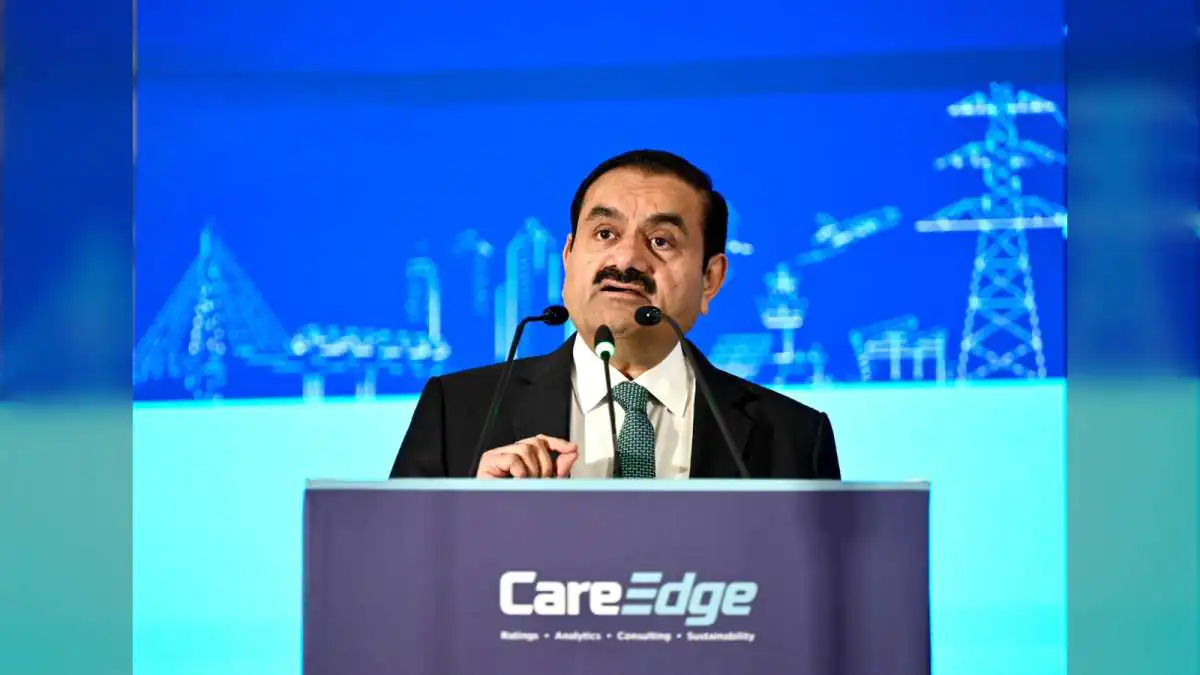
His central message was clear. India has entered a new era, and the frameworks used to evaluate its infrastructure must evolve to match the ambition of what is now being built.
'The Nature of Infrastructure Has Changed'
Setting the tone of his address, Adani made an important structural observation about where India now stands.
"India has now entered a very different period. The nature of infrastructure has changed, and the sophistication of our rating frameworks must evolve alongside the sophistication of what India is building," he said.
That framing — pushing rating agencies to update their evaluative lens — reflects a growing conversation within Indian industry about how conventional risk-assessment tools often underestimate the transformational potential of large infrastructure investments.
His subsequent line landed even more sharply.
"If we build only for the demand we can see today, India will always be late for the opportunities of tomorrow," Adani remarked.
That single sentence captures the philosophical heart of his entire address — the argument that Indian infrastructure must be built with anticipatory ambition, not just reactive demand-matching.
Mundra: The Case Study for Ecosystem Creation
Adani offered the Mundra port as a prime illustration. Today, Mundra stands as India's largest port. But three decades ago, he pointed out, a traditional rating assessment would have dismissed it as a marshy coastline with no industrial ecosystem to speak of.
"Today, Mundra is easily one of India's most important commercial gateways. But more importantly, Mundra has created an ecosystem multiple times the size of the port. It is a port connected to rail. Rail connected to logistics centres. Logistics connected to power plants. Power connected to industrial zones. Industrial zones connected to traders and manufacturers all across India," Adani said.
That's the argument in its most tangible form. Mundra didn't just serve demand — it created the conditions for entirely new economic activity to emerge around it.
Vizhinjam: The Sovereignty Story
If Mundra was Adani's example of ecosystem-building, Vizhinjam was his example of national sovereignty. The Kerala-based deep-water port project had struggled to find takers for 25 years, with the capital risk considered "too immense" despite the strategic need. The Adani Group eventually stepped in and built it.
"We sat just 10 nautical miles from the world's busiest shipping routes, yet we could not handle our own container cargo. We had to tranship through Singapore, Dubai, and Colombo. For decades, Indian commerce paid a direct sovereignty tax to foreign ports simply because domestic infrastructure was deemed too risky for institutional capital," Adani highlighted.
That "sovereignty tax" framing is striking. It reframes decades of India's dependency on foreign transhipment hubs not as a logistical inconvenience but as an ongoing economic cost extracted from the country by the absence of domestic infrastructure. Vizhinjam, in his framing, wasn't just a port. It was a correction of that structural leak.
Khavda: More Than a Renewable Project
Adani then turned to Khavda — the massive renewable energy project that, on a conventional assessment, might look like a harsh desert with execution risk and uncertain demand.
"But what is missed is that Khavda is not a renewable energy project. Khavda is a platform where energy, artificial intelligence, manufacturing, digital infrastructure and industrial capability converge at an unprecedented scale," he observed.
That framing is significant. It positions Khavda not as a standalone clean-energy play but as an integrated platform that could underpin India's next generation of high-compute, AI-driven economic activity.
"It can provide the clean electrons required to power India's future compute infrastructure. It is the foundation for India's AI manufacturing ecosystem. It can become part of the foundation upon which India's AI economy is built," Adani added.
That's a bold, forward-looking claim — and one that reframes clean energy investment as a strategic enabler for India's AI-era economy rather than merely a climate transition play.
The Bigger Structural Argument
Threading his examples into a broader message, Adani spoke to how India's infrastructure ambitions have historically been constrained.
"India's infrastructure ambitions were earlier constrained by limited resources, limited capability, and limited confidence. However, today, India has resources and has demonstrated its capability, but more importantly, discovered a belief in its own potential which ultimately changes the future of a nation," he asserted.
That belief-driven framing is quietly powerful. It suggests that the biggest constraint on transformational infrastructure is often not capital or capability but conviction — and that India has now crossed that threshold.
India's Infrastructure Momentum
Highlighting the pace of India's current build-out, Adani noted that roads, ports and airports are expanding at unprecedented speed. He said renewable energy capacity is growing faster in India than in any other nation on earth, and that digital infrastructure now reaches hundreds of millions of Indians.
Those three data points together — roads, energy and digital reach — form the foundation of what many economists now describe as India's next decade of structural growth.
Why It Matters
Gautam Adani's remarks land at an important moment. India is investing in infrastructure at scale, but debates around risk-assessment, capital allocation and rating agency methodology continue to shape how large projects get financed. When one of India's most prominent industrial voices explicitly calls for rating frameworks to evolve alongside the changing sophistication of Indian infrastructure, it opens up a serious policy conversation.
His argument that big projects create new economics — rather than merely responding to existing ones — challenges a long-standing conservative bias in institutional capital deployment. If applied thoughtfully, it could reshape how future infrastructure projects are evaluated, financed and built across sectors.
Industry Impact
For India's infrastructure sector, Adani's articulation provides a broader intellectual framework for justifying long-cycle, high-capex projects. For rating agencies, the address is a direct nudge to review whether their traditional methodologies fully capture the transformational potential of ecosystem-building projects. For institutional investors, it is an invitation to reconsider how they price transformative infrastructure.
For the wider Indian economy, the message is even more consequential. If India intends to build for the tomorrow it wants — rather than only for the demand of today — that ambition needs matching frameworks, matching capital, and matching belief across every layer of decision-making.
Cultural and Policy Impact
There is also a cultural dimension to Adani's speech. India's infrastructure story has often been discussed defensively — through the language of risk, cost overruns and execution challenges. Adani's reframing shifts that narrative into a more confident register — one that centres ambition, ecosystem effects and long-term sovereignty gains rather than immediate cost-benefit calculations.
For policymakers, that reframing offers useful language for defending and championing large capital-intensive projects that may look expensive on paper but pay off structurally over decades.
The Bigger Picture
Gautam Adani's address at the CareEdge summit is more than a case study of three projects. It is a broader manifesto on how India should think about the infrastructure it is building for the coming decades. Mundra as ecosystem. Vizhinjam as sovereignty. Khavda as an AI-era enabler.
Each of these examples underscores a common theme — that the value of transformational infrastructure is often invisible in traditional demand-based analysis, but visible everywhere in the economic transformation that follows once the infrastructure exists.
As India moves deeper into its next phase of growth — one increasingly defined by AI, clean energy, digital reach and global supply chain shifts — the country's willingness to build not just for today but for tomorrow will shape the trajectory of the coming decade. And on Monday in Mumbai, one of India's most prominent industrialists made a compelling case for exactly that kind of ambition — arguing, in effect, that the projects worth investing in are the ones that don't just serve the economy that exists, but create the economy that hasn't been built yet.
Also Read: Adani Group to Build 2,000-Bed Hospital Near Kolkata