For everyone involved in the rescue — from the shepherd who first heard her, to the community health workers who responded, to the doctors now caring for her — the priority is now clear. Every step going forward must be about ensuring her safety, her medical recovery and her long-term wellbeing.
The Rescue
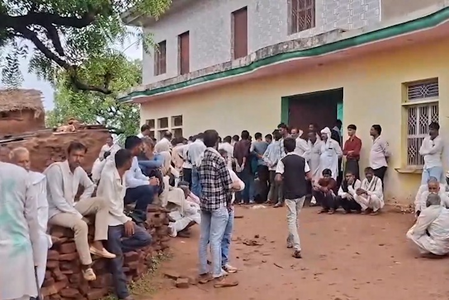
The infant was found in Dungariya Khurd village under Bamhauri tehsil on Tuesday. A shepherd grazing livestock in the area heard her cries, followed the sound, and discovered the baby in a forested spot with no one else present.
He immediately informed ASHA and Anganwadi workers — India's frontline community health functionaries who play a critical role in exactly these kinds of emergency situations. Police and villagers subsequently reached the location and rescued the infant.
That quick, coordinated response — from a shepherd's alertness to community health workers to police — reflects exactly what the ASHA and Anganwadi system is designed for. It is a small but genuinely important example of how India's rural community health infrastructure can save lives when it works as intended.
The Medical Care
The baby was initially taken to the Bamhauri Sub-Health Centre and subsequently referred to hospitals in Silwani and Raisen as her condition was considered serious.
At the Raisen District Hospital, she has been admitted to the Sick Newborn Care Unit (SNCU), where doctors are keeping her under close observation.
SNCU in-charge Dr Alok Rai confirmed that the baby is currently receiving intensive care and being monitored carefully. India's SNCU network was established precisely to provide specialised neonatal care in exactly these kinds of situations — and Raisen District Hospital's SNCU is now doing what it is designed to do.
The Police Investigation
Bamhauri police have registered a case against unknown persons and launched an investigation to identify those responsible for the abandonment.
Bamhauri police station house officer Pritam Singh Rajput confirmed that the investigation is being handled with the seriousness it warrants. "We have registered a case against unknown persons and are making inquiries in the surrounding villages to identify the parents," he said.
Police teams are conducting inquiries in the surrounding villages as part of the ongoing investigation.
The Child Welfare Committee Steps In
Perhaps the most important institutional development in the case is the involvement of the Child Welfare Committee (CWC) — the statutory body designated under India's juvenile justice framework to handle exactly these situations.
Child Welfare Committee member Mamta Patel visited the district hospital after learning about the incident and enquired with doctors about the infant's condition and treatment. The committee has initiated the process for further action concerning the abandoned child, she told media on Wednesday.
Patel also confirmed that the baby will remain under medical supervision for the next three to four days as her recovery continues.
The CWC's involvement is exactly what should happen in such cases. India's juvenile justice architecture provides a structured, child-centric framework for handling abandoned and vulnerable infants — one designed to prioritise the child's safety, medical wellbeing, and long-term future above all else.
Why the Institutional Response Matters
Cases like this one are, ultimately, tests of whether India's child protection systems function as they are designed to. On Tuesday and Wednesday in Raisen, several parts of that system responded exactly as they should have.
A community member acted with urgency the moment he heard the child. ASHA and Anganwadi workers responded immediately. Police coordinated the rescue and initiated a formal investigation. The Sub-Health Centre triaged and escalated. The District Hospital SNCU took over medical care. And the Child Welfare Committee stepped in to oversee the child's welfare going forward.
That kind of chain of institutional response, when it works, saves lives.
The Path Ahead
For the baby now recovering in the Raisen District Hospital SNCU, the coming days will be about medical stabilisation and observation. Beyond that, her longer-term welfare is now formally in the hands of the Child Welfare Committee, which is empowered under the Juvenile Justice (Care and Protection of Children) Act to make decisions that centre the best interests of the child.
Whatever pathway her life takes from here — whether through family tracing, foster care or eventual adoption through the Central Adoption Resource Authority (CARA) framework — the process is now structured to prioritise her safety, dignity and future.
A Note on Reporting
Cases involving newborn children require care, both in how they are handled institutionally and in how they are reported publicly. India's child protection framework — including the Juvenile Justice Act and Press Council of India norms — provides clear guidance on protecting the privacy, identity and long-term interests of vulnerable minors. As this case unfolds, the primary focus should remain on the institutional response, the child's welfare, and the systems working to protect her — rather than on speculation, graphic detail or coverage that could complicate her future.
The Bigger Picture
The rescue in Raisen is, at its core, a story about a child whose life was saved by the alertness of a shepherd, the responsiveness of community health workers, the coordination of local police, and the institutional structures that India has built specifically for such moments.
The chain that saved her — from the pasture where she was found to the SNCU bed where she now recovers to the CWC that is now overseeing her future — represents the quiet, everyday functioning of a child protection ecosystem that most people never think about, but which exists precisely for moments like these.
For everyone reading about this case with concern, the most helpful thing to hold onto is not the difficulty of what happened but the strength of the response that followed. A baby who was in genuine danger is now safe, receiving care, and has an entire institutional framework working to protect her going forward.
Her future will be shaped in the weeks and months ahead by the CWC, the medical team caring for her, and the child protection systems designed to ensure that children like her get the safety, dignity and care every child deserves.
And in that ongoing work — quiet, careful, and rarely making headlines — sits some of the most important, most humane work being done by India's public institutions every single day.