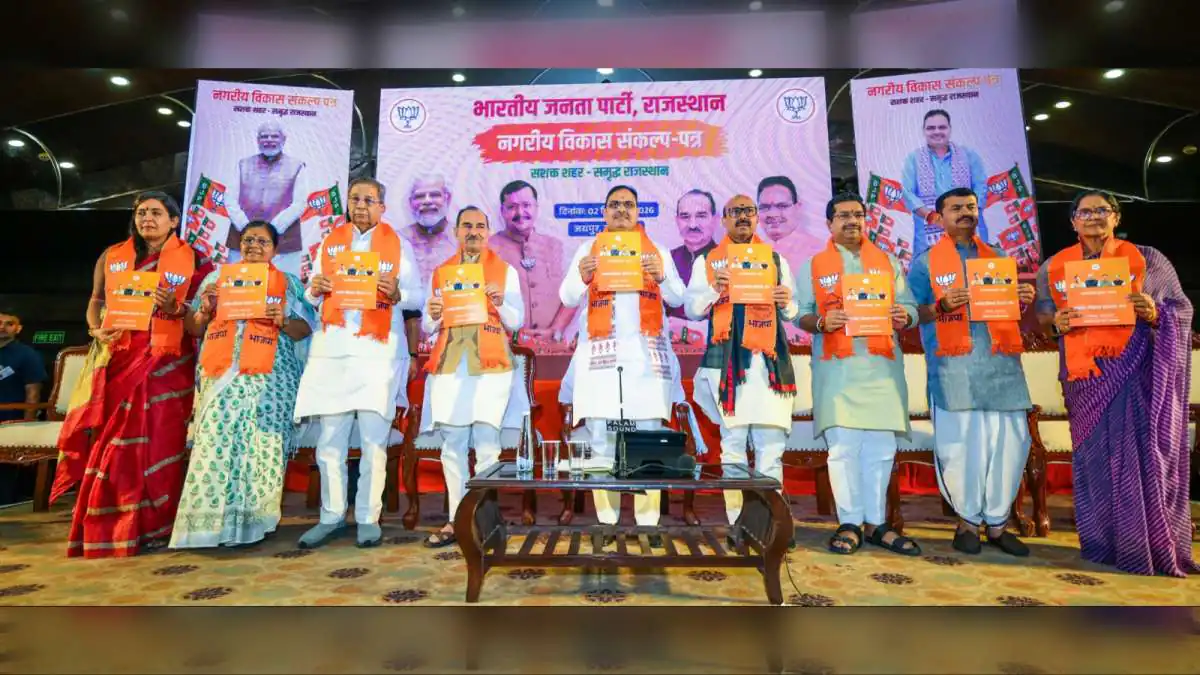
For citizens of Rajasthan's cities and towns, and for anyone following the state's political trajectory, Wednesday's release offers a substantive articulation of what the ruling party is proposing for urban governance over the coming years.
The Central Commitments
The BJP's Urban Development Sankalp Patra includes a set of specific, tangible commitments across critical urban service categories.
At the heart of the document sit several major promises. PNG connections for 7 lakh households across Rajasthan — a substantial expansion of piped natural gas coverage that would meaningfully change household energy access across urban areas. 24-hour domestic electricity supply in urban areas — addressing one of the most fundamental quality-of-life expectations in any modern city. Improved drinking water supply in civic bodies facing shortages — addressing a persistent challenge for many urban local bodies across the state. And treating the ward as the fundamental unit of urban development — a governance philosophy that emphasises decentralised, ward-level responsiveness.
Additionally, the party has committed to releasing separate Sankalp Patras for individual civic bodies — incorporating local priorities and requirements specific to each municipal corporation, municipality and urban local body across the state.
The Chief Minister's Framing
Chief Minister Bhajanlal Sharma placed particular emphasis on the language chosen for the document — deliberately calling it a Sankalp Patra rather than simply a manifesto.
"We have released the Urban Development Sankalp Patra today because a manifesto is merely for making announcements, whereas a Sankalp Patra is about getting work done," Sharma said.
That framing signals the party's intent to position the document as a working commitment rather than a routine election-time announcement. It's a subtle but meaningful linguistic distinction — one that aims to convey a stronger sense of accountability and action orientation.
Sharma added that the document represents a five-year commitment to the people of Rajasthan — outlining the BJP government's approach to urban development for the coming years.
The 'One State, One Election' Reference
The Chief Minister also used the occasion to reference the state government's proposal to implement 'One State, One Election' — an ambitious governance reform aimed at synchronising various levels of state elections.
Recalling earlier political criticism of the proposal, Sharma made a pointed remark about the reform's progress.
"When I stated in the Legislative Assembly that we would implement 'One State, One Election,' a senior Congress leader remarked that even my uncle couldn't pull it off. Now, let him see for himself exactly which 'uncle' is making 'One State, One Election' happen," Sharma said.
That kind of confident political framing is characteristic of ruling party leaders showcasing their governance ambitions ahead of important electoral cycles.
The State BJP President's Statement
State BJP President Madan Rathore also spoke at the event, emphasising the party's confidence in delivering on the commitments articulated in the Sankalp Patra.
"The public trusts CM Bhajanlal Sharma's guarantee. Today, we have released the manifesto for urban civic bodies. We do what we say. We are firmly committed to fulfilling this manifesto," Rathore said.
He further offered a broader political framing — inviting voters to judge the current government's performance against the record of previous administrations. "The public knows and understands the history — what others said and did versus what we said and did," Rathore said, adding that the people had witnessed the government's work and understood its performance.
That kind of governance-vs-governance comparative framing is a familiar feature of political campaigning worldwide — with parties typically inviting voters to make choices based on relative track records.
The Committee Behind the Document
The BJP's process for developing the Sankalp Patra reflects a structured, consultative approach.
On August 2, the party constituted a 13-member election manifesto committee to prepare the Urban Development Sankalp Patra. The committee included Rajya Sabha MP Ghanshyam Tiwari, former MPs Santosh Ahlawat and Rajendra Kumar Gehlot, State General Secretary Shravan Singh Bagdi, former MLA Mohanlal Gupta and former Jaipur Mayor Saumya Gurjar — among other members.
According to the party, the committee completed the document within 30 days after holding consultations and preparing the proposals for urban development. That 30-day preparation timeline reflects reasonable diligence for a document of this scope and significance.
The party will now prepare and release separate Sankalp Patras for individual civic bodies ahead of the Rajasthan urban local body elections — allowing each ULB-specific document to reflect the particular needs and priorities of that community.
The Ward-Level Focus
Perhaps the most structurally interesting element of the Sankalp Patra is the party's commitment to treating the ward as the fundamental unit of urban development. That's a governance philosophy that emphasises decentralised, hyperlocal responsiveness to citizen needs.
Ward-level focus means that the everyday concerns of citizens — road quality, drainage functionality, sanitation, streetlights, local parks, waste collection — receive dedicated attention through structured governance mechanisms rather than being left to broader city-level or state-level processes.
If implemented effectively, that kind of ward-first approach can meaningfully improve the responsiveness of urban local governance to citizen needs.
Why It Matters
Urban local bodies play a critical role in delivering the everyday public services that shape quality of life in cities. Water supply. Electricity distribution coordination. Drainage. Sanitation. Solid waste management. Street lighting. Local road maintenance. Neighbourhood infrastructure. All of these are areas where the effectiveness of municipal governance directly affects citizens' daily lives.
When a ruling party articulates specific, measurable commitments across these categories, citizens gain a concrete framework against which they can eventually evaluate performance. That kind of clear articulation is exactly what strengthens democratic accountability in urban governance.
For Rajasthan's urban voters, the coming civic elections will provide an opportunity to weigh the Sankalp Patra's promises against their own experiences and expectations — and to choose leaders accordingly.
The Substantive Commitments Analysed
Each of the major commitments in the Sankalp Patra addresses a substantive urban development priority.
PNG for 7 lakh households represents a meaningful expansion of piped natural gas coverage — a cleaner, more convenient cooking fuel option that would benefit household economics, air quality and daily convenience across urban Rajasthan. Executing this at scale would require coordinated infrastructure investment, utility partnerships and structured rollout planning across cities.
24-hour domestic electricity supply in urban areas addresses one of the most fundamental quality-of-life expectations. Achieving this consistently across all urban centres would require sustained investment in generation, transmission, distribution infrastructure and grid reliability.
Improved drinking water supply in civic bodies facing shortages tackles a persistent challenge across many Rajasthan cities and towns. Delivering meaningful improvement would require investment in water source development, storage capacity, distribution infrastructure and reduction of transmission losses.
Ward-level focus, if implemented with genuine institutional discipline, could improve responsiveness across dozens of everyday urban service categories.
Each of these commitments, taken seriously, represents genuinely valuable urban development work.
Institutional Impact
For Rajasthan's Urban Development Department, its urban local bodies, its utility providers and its municipal administrations, the Sankalp Patra's commitments — if the BJP performs well in the civic polls — would translate into a substantial urban development agenda over the coming years.
Coordinated implementation across water, power, gas, waste management, roads and citizen services would require significant institutional capacity, sustained financial resources, and disciplined execution across multiple stakeholder groups.
Political and Electoral Impact
For Rajasthan's political landscape, the BJP's structured approach to the civic polls — combining a state-level Sankalp Patra with subsequent locality-specific versions — reflects a comprehensive electoral strategy focused on urban voters.
For opposition parties in the state, the Sankalp Patra sets out a set of specific commitments that they will inevitably examine, critique and offer alternatives to over the campaign period. That kind of substantive electoral debate — around concrete governance commitments rather than only around personalities — is exactly what strengthens democratic engagement.
Citizen and Civic Impact
For Rajasthan's urban citizens, the Sankalp Patra offers a concrete framework against which they can evaluate the ruling party's proposals ahead of the civic polls. It also provides a benchmark for eventually assessing performance if the BJP secures mandates in the urban local body elections.
For civic organisations, resident welfare associations and citizen advocacy groups, the specific commitments in the document create useful anchors for constructive engagement with elected representatives after the polls.
The Bigger Picture
The BJP's Wednesday release of its Urban Development Sankalp Patra represents a substantive political and governance moment ahead of Rajasthan's civic polls. Ambitious commitments across piped gas, electricity, water supply, ward-level focus and locality-specific responsiveness. A structured process anchored by a 13-member manifesto committee. Clear leadership framing from Chief Minister Bhajanlal Sharma and State BJP President Madan Rathore. And plans for subsequent locality-specific documents to complement the state-level release.
For Rajasthan's urban voters, the coming weeks will bring an active electoral campaign — during which the Sankalp Patra's commitments, opposition parties' alternatives, and candidates' individual profiles will all shape voting decisions.
For India's broader democratic conversation about urban governance, the Rajasthan civic polls represent one more important chapter in the ongoing story of how urban local bodies are chosen, held accountable and evolve over time.
As the civic polls approach, and as the political campaign intensifies across Rajasthan's cities and towns, the message from Wednesday's Sankalp Patra release is clear. The ruling party has laid out its commitments. The document has been anchored in specific promises. The five-year framework has been articulated. And the invitation to voters has been formally extended.
What now follows will be the everyday work of democratic engagement — with voters weighing options, comparing alternatives, evaluating track records, and eventually casting their choices at the polls. That process, when it works well, is exactly how healthy democracies produce responsive urban governance.
For Rajasthan's citizens, the coming weeks offer exactly the kind of opportunity for informed civic participation that meaningful local elections are designed to enable. And when the votes are eventually counted and the new urban local bodies take office, the substantive work of turning promises into performance — across piped gas, electricity, water, ward-level responsiveness and everything else — will begin in earnest across cities and towns throughout the state.