





























Gujarat Food Security Scheme Reaches 1.14 Crore in 5 Years

Gujarat's Food Security Scheme has covered over 1.14 crore beneficiaries from 25 lakh families in five years, distributing subsidised wheat, rice and coarse grains.

Raaisha Upadhyay
Raaisha Upadhyay Verified Public Figure • 16 Mar, 2026 Editor
Aug 26, 2026 • 10:00 PM  1
N
National
NEWS CARD
Logo
Gujarat Food Security Scheme Reaches 1.14 Crore in 5 Years
“Gujarat Food Security Scheme Reaches 1.14 Crore in 5 Years”

Favicon
Read more on en.nav18.in/s/d7c2e1
26 Aug 2026
https://en.nav18.in/s/d7c2e1
Copied
Gujarat Food Security Scheme Reaches 1.14 Crore in 5 Years

Key Highlights

  • Over 1.14 crore beneficiaries from 25 lakh-plus families have received foodgrains under Gujarat's Food Security Scheme in the past five years.
  • Beneficiary coverage jumped from 14.48 lakh in 2022-23 to 39.65 lakh in 2025-26 — a nearly threefold rise in three years.
  • Wheat, rice, sugar, edible oil, gram and coarse grains are distributed monthly and during festivals, free or at subsidised rates.
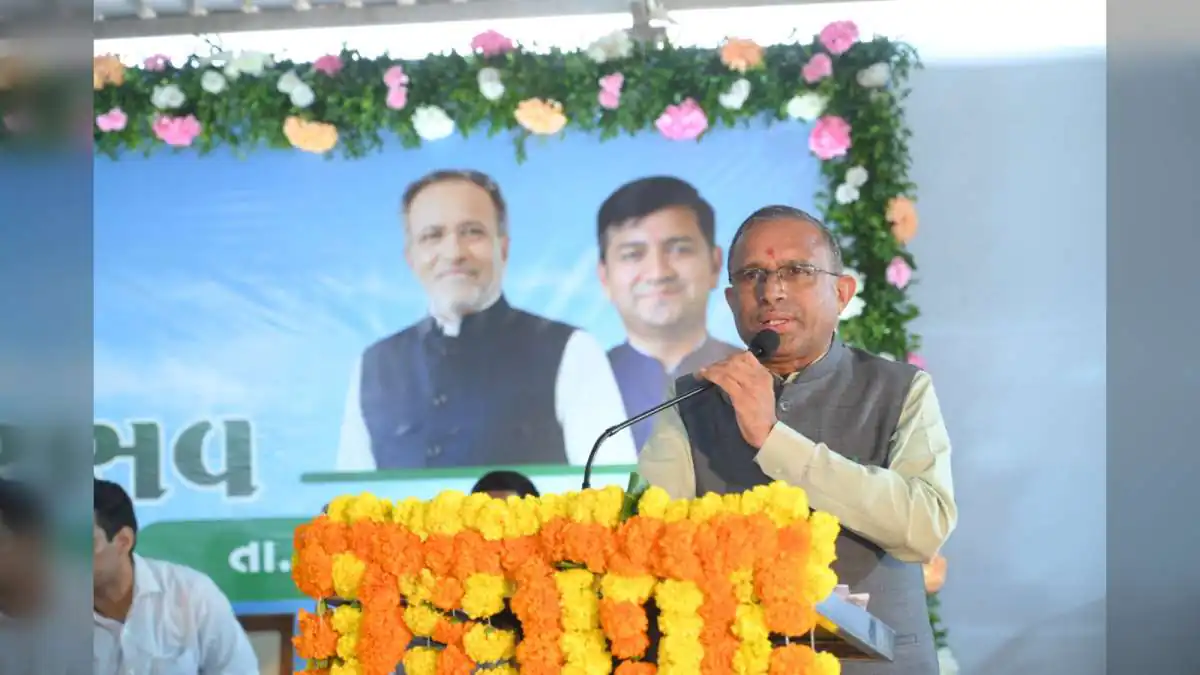
  • Food and Civil Supplies Minister Raman Solanki credited CM Bhupendra Patel's leadership for the scheme's expansion.
  • Annual foodgrain distribution expenditure has ranged between Rs 6,761 lakh and Rs 11,677 lakh across the five-year window.

Gujarat's Food Security Scheme has emerged as one of the state's most far-reaching welfare interventions, with more than 1.14 crore beneficiaries from over 25 lakh families receiving foodgrains over the past five years. According to fresh data released by the Food and Civil Supplies Department on Wednesday, the government has distributed wheat, rice and coarse grains — either free of cost or at heavily subsidised rates — as part of an expanding safety net for the state's most vulnerable households.


The Scheme at a Glance

Food and Civil Supplies Minister Raman Solanki said the state government has taken several measures to strengthen food security under the leadership of Chief Minister Bhupendra Patel. "Beneficiaries are provided wheat, rice, sugar, edible oil, gram and coarse grains on a monthly basis and during various festivals," he said. The scheme's design — combining monthly rations with festival-linked distribution — is aimed at ensuring both consistent nutritional access and dignity during culturally significant periods.

A Sharp Upward Curve in Coverage

The most striking takeaway from the data is the sheer pace at which the scheme has scaled. In 2022-23, 3,06,026 families comprising 14,48,943 beneficiaries were covered. That number rose to 5,63,406 families and 25,43,101 beneficiaries in 2023-24. By 2024-25, coverage had climbed to 7,49,252 families and 34,53,403 beneficiaries. In 2025-26, the scheme reached 9,20,610 families covering 39,65,325 beneficiaries — nearly three times the 2022-23 figure in just three years.

Foodgrain Distribution: The Numbers Behind the Reach

The volume of grain moved through the system tells a story of large-scale logistical execution. In 2021-22, the state distributed 26.91 lakh metric tonnes of wheat and 12.57 lakh metric tonnes of rice. In 2022-23, distribution stood at 12.66 lakh MT of wheat and 22.70 lakh MT of rice. The following year, 2023-24, saw 9.20 lakh MT of wheat, 11.03 lakh MT of rice and 1.28 lakh MT of coarse grains distributed.

In 2024-25, the state moved 10.48 lakh MT of wheat, 11.35 lakh MT of rice and 0.84 lakh MT of coarse grains. In 2025-26, the distribution stood at 8.76 lakh MT of wheat, 10.45 lakh MT of rice and 0.88 lakh MT of coarse grains.

The Fiscal Footprint

The government's spending on the scheme has remained substantial. Expenditure on foodgrain distribution was Rs 11,118.10 lakh in 2021-22, including Rs 6,640.04 lakh on wheat and Rs 4,478.06 lakh on rice. It stood at Rs 11,677.77 lakh in 2022-23, Rs 6,761.85 lakh in 2023-24, Rs 7,665.94 lakh in 2024-25 and Rs 7,001.25 lakh in 2025-26.

Why It Matters

For a state often defined by its industrial and economic headlines, the food security data offers a different lens on Gujarat — one focused on welfare delivery at scale. The tripling of beneficiary coverage in three years suggests either aggressive identification of eligible households, improved last-mile delivery, or both. Either way, it points to a growing role for the state in cushioning inflation-hit families against rising food costs.

Transparency and Delivery Focus

According to the Food and Civil Supplies Corporation, the state government has sought to ensure timely and transparent delivery of foodgrains to eligible beneficiaries. This emphasis on transparency is particularly significant given the historical challenges around leakage and diversion in public distribution systems across India.

The Bigger Picture

Gujarat's five-year data effectively benchmarks food security as a core plank of the state's governance model. With nearly 40 lakh beneficiaries currently on the rolls and consistent multi-thousand-crore expenditure sustaining the scheme, the direction of travel is unmistakable: broader coverage, larger volumes, and a welfare architecture designed to keep pace with the state's growing at-risk population.

favorite Follow us for the latest updates:

Raaisha Upadhyay Verified Public Figure • 16 Mar, 2026 Editor

Digital Archives

home Home amp_stories Web Stories local_fire_department Trending play_circle Videos mark_email_unread Newsletter